Valentina Paolucci’s Journey from Violinist to Conductor
Interview by Maryam Ali
September 30, 2026
New York, NY—What does it take to move from playing an instrument to leading an entire ensemble? For rising conductor Valentina Paolucci, the answer lies in a desire for self-expression and deeper connection with the environment at the stage. In this conversation before her October 17 and 18, 2026 debut with the New Conductors Orchestra, Paolucci reflects on her transition from violin to conducting, her commitment to contemporary works, and her thoughts on advancing women in orchestral leadership.
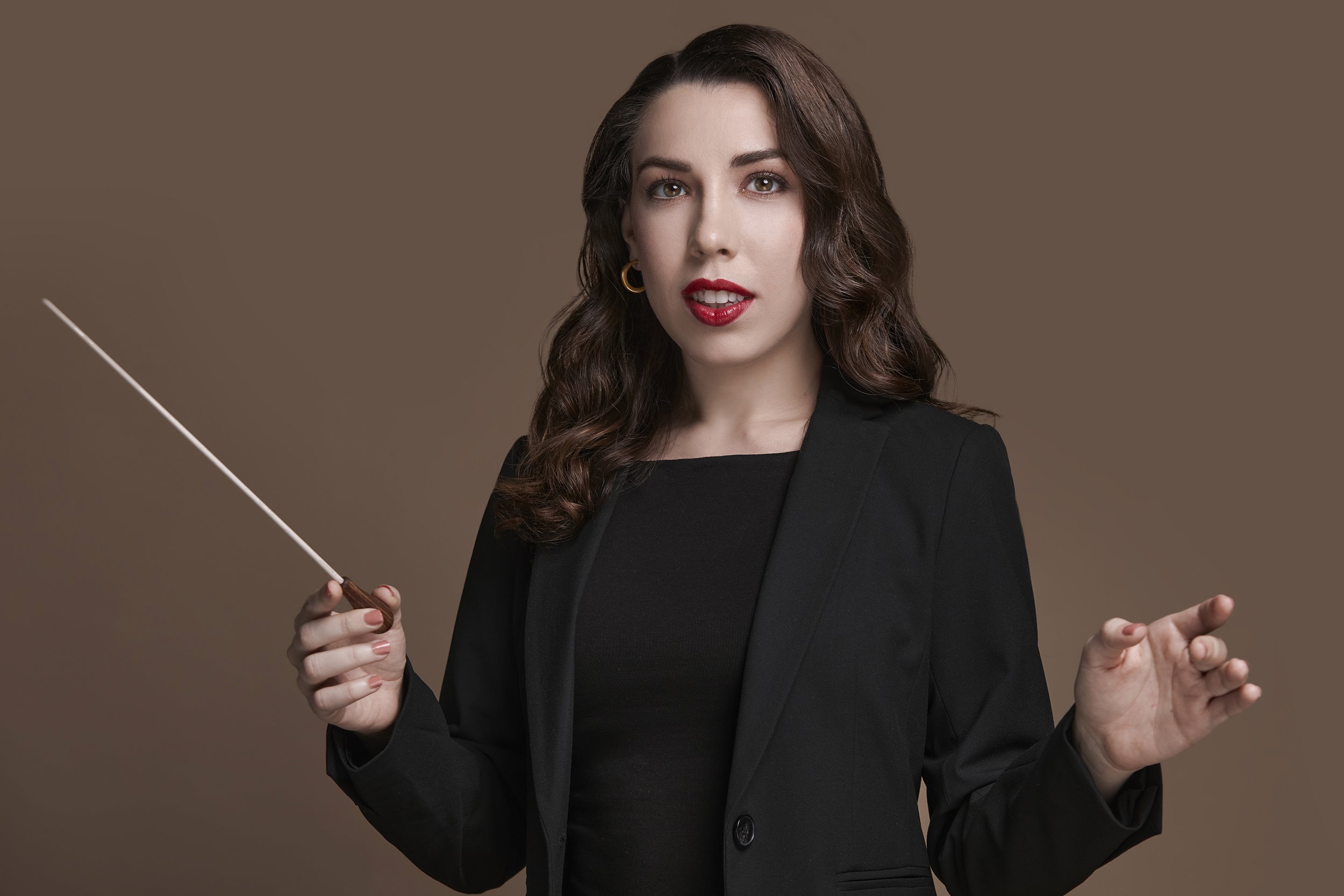
A Juilliard-trained conductor based in New York City, Valentina Paolucci is currently a Conducting Fellow with The Chelsea Symphony and the New Haven Symphony Orchestra, as well as Music Director of the NYO-USA Alumni Orchestra at Carnegie Hall. Her engagements include performances with the Zhixing Symphony Orchestra, Brandenburger Symphoniker, Lüneburger Symphoniker, Orchestre Métropolitain, National Arts Centre Orchestra, Athens Philharmonia Orchestra, Richmond Symphony, and Jackson Symphony, as well as orchestras in Romania, Finland, Bulgaria, and Panama. She has also assisted conducted with the New York Philharmonic, Chicago Sinfonietta, Rhode Island Philharmonic, Grand Rapids Symphony, and Accademia Nazionale di Santa Cecilia, working with renowned conductors such as Gustavo Dudamel, Daniel Harding, Ruth Reinhardt, Cristian Măcelaru, Marin Alsop, Ken-David Masur, Mei-Ann Chen, and David Robertson.
Could you walk us through your path from violinist to conductor? When did you realize you wanted to make that pivot?
Paolucci: I started playing violin when I was five years old, in an El Sistema-based orchestral program. Most of us were assigned to teach younger musicians, so I think that’s where some of my earliest experiences with leadership began. We went through an extensive portion of the standard orchestral repertoire by the time I was 18, so although I fell completely in love with the music, I also started feeling like I couldn’t express everything from my instrument alone. I deeply loved studying, whether it was scores, books, history, performance traditions, and developing my own interpretations.
It was toward the end of high school that my curiosity for conducting started. But the reality was that I had never really seen anyone who looked like me doing it, so I wasn’t sure if it was actually possible.
When I was 18, I went on tour in Europe with the National Youth Orchestra, and we played under Antonio Pappano in halls including the Concertgebouw, Konzerthaus Berlin, the BBC Proms, the Elbphilharmonie, and Carnegie Hall. We were performing Strauss’s Alpine Symphony at the BBC Proms, and I remember feeling this incredibly intense connection to everything at once - the orchestra, the audience, the conductor, the composer, and of course, to the music itself. I realized that the feeling I was searching for might only really be possible for me on the podium. From that day on, I promised myself I was just going to go for it.
During the pandemic, you founded your own orchestra in Miami to gain experience. How did those early, self-initiated rehearsals shape your approach to leadership?
Paolucci: Funny enough, the first time I decided to actually try conducting was in March 2020, the day before the national shutdown (the timing almost felt like an omen). I took advantage of the quarantine and spent months just swallowing scores and books day and night. By the time I went back to school, I had decided that I wanted to conduct and rehearse a real orchestra for the first time. So I put together a full string orchestra and, coincidentally, we played Grieg’s Holberg Suite, which I’m conducting with the NCO! I still remember the feeling of conducting that day. I hadn’t studied any baton technique yet or really anything besides the beat patterns, but the feeling I had been searching for since the BBC Proms was suddenly back.
The most beautiful part of conducting these orchestras regularly was that they became a safe place for me to learn. Every person in the orchestra was supportive and genuinely wanted the best for me. Conducting is a difficult career because the only way you can actually learn it is in front of a full group of people. It makes an enormous difference when those people are kind, patient, and supportive.
Those experiences really shaped the kind of leader I want to be. I want to create an environment where musicians feel respected and comfortable, because I know firsthand how much that kind of environment can help someone grow.
You have worked with many composers, including Jennifer Higdon, John Adams, and Augusta Read Thomas. Why is contemporary music important to your artistic vision?
Paolucci: I know everyone says it, but all music was once new. We as humans have always gravitated toward novelty, even as a modern society, we’re constantly watching new movies, listening to new music, wearing new styles, and following new trends. I believe we should have that same openness toward contemporary music, not simply because it’s new and exciting, but because it reflects the life we’re living right now, or it views the past and the present through today’s lens.
Our human rights, political realities, environmental challenges, and personal experiences are all reflected in art. Composers are responding to the world around them in real time, and I think it’s our responsibility as conductors to help bring that music to life and make sure it has a place in the concert hall. I might even say that as a conductor, our programming and care for the pieces of living composers is our most important job.
Do you feel the door is opening wider for women in orchestral leadership right now?
Paolucci: I do. I think we’re seeing a positive shift in our leadership culture, and I’m hopeful that this momentum will continue and balance out over time. What feels especially meaningful to me is that younger generations are growing up seeing people from diverse backgrounds in leadership positions. That visibility means they can imagine themselves in those roles without having to question whether those opportunities are possible for them. At the same time, I think it’s important to acknowledge that there’s always more work to be done, and that the situation here in the United States is different from what it looks like in other countries. However, I’m very grateful to be part of a generation that is seeing that change happen, and I know the next generations will take it even further.
What do you enjoy doing most?
Paolucci: I love connecting with other people, in any way, shape, or form. Of course, making music - whether it’s playing chamber music, in an orchestra, or conducting - is what I live and breathe for. But outside of music, I really just love hanging out with friends, meeting new people, having meaningful conversations, and just having fun. I think that’s probably one of the things I love most about being a musician, too - you get to connect with so many different people from all around the world.
Valentina Paolucci will be conducting for the New Conductors Orchestra’s in our “ORCHESTRAL VOICES” concert series, leading the orchestra in performances of Grieg’s Holberg Suite and Toews’ Mirrors in Haida Gwaii (U.S. premiere). The complete concert program is as follows:
Paul Dukas Fanfare from La Peri
Giovanni Gabrieli Canzon Septimi Toni No. 2 and Canzona per Sonare No. 2
Billy Joel And So It Goes (arr. Gareth Lewis)
W.A. Mozart selections from Gran Partita (Wind Serenade No. 10)
Edvard Grieg Holberg Suite
Samuel Barber Knoxville: Summer of 1915 (featuring Sydney Kucine as soprano soloist)
Joel Toews Mirrors in Haida Gwaii (2022) (U.S.premiere)
Tickets to the concerts are now available for purchase.
About New Conductors Orchestra
Founded in 2019, the New Conductors Orchestra (NCO) is a unique community ensemble that champions the next generation of musical leaders. With no set conductor, NCO engages emerging talent from the conducting world, offering them the opportunity to lead dynamic, high-level performances. Through these concerts, NCO bridges the gap between formal conducting education and the professional world, while also featuring works by both classical and living composers. Under the guidance of Lead Conductor Mark Powell, NCO is determined to nurture a collaborative environment where conductors and musicians alike can shape their musical journey.
For Media Inquiries
Publicity and Communications/New Conductors Orchestra
Maryam Ali | business.maryamali@gmail.com